A tile shower is the one job in a house where almost all of the important work is invisible when it is finished.
The tile is the part you choose and the part you look at. The waterproofing behind it is the part that decides whether the shower is still sound in fifteen years, and it is the part that gets skipped or done cheaply when a job is priced to be the lowest number.
A shower is a waterproofing system, not a tiled wall
Tile is not waterproof. Grout is not waterproof. Both are water-resistant surfaces that slow water down, and a working shower assumes water will get past them.
So behind the tile there has to be a continuous waterproof layer that catches everything that gets through and takes it to the drain. That layer is the shower. The tile is the wearing surface on top of it.
When a tile shower fails, it is almost never the tile that failed. It is a gap in that layer — usually at a corner, a change of plane, or where the wall meets the pan.
What goes in, in order
The substrate
Ordinary drywall does not belong in a wet area. The backing is either a cement board, a foam board, or a purpose-made waterproof panel. Boards are set with the correct gaps and fastened on the specified pattern, because the waterproofing over the top is only as reliable as what it is stuck to.
The pan
The floor of the shower has to slope evenly to the drain, at a consistent fall, with no flat spots and no dips holding water. This is either a pre-formed sloped pan or a mortar bed built to fall.
A pan that ponds is the most common complaint we hear about showers built by someone else, and it cannot be corrected afterwards without taking the floor out.
The waterproofing
Either a liquid membrane rolled or brushed on in the specified number of coats, or a sheet membrane bonded to the substrate. Both work. Both depend entirely on the detailing at the transitions.
The corners, the wall-to-floor junction, the drain connection and any niche or bench are where the reinforcing tape and preformed corners go in. That detailing is the job. A membrane rolled flat across an open wall is easy; the corners are where the skill is.
The slope on horizontal surfaces
Anything flat inside a shower has to be sloped enough to drain — the shelf in a niche, the top of a bench, the top of a curb. A flat niche shelf holds a puddle behind the shampoo bottles indefinitely, and it is a detail that is very often missed.
The tile
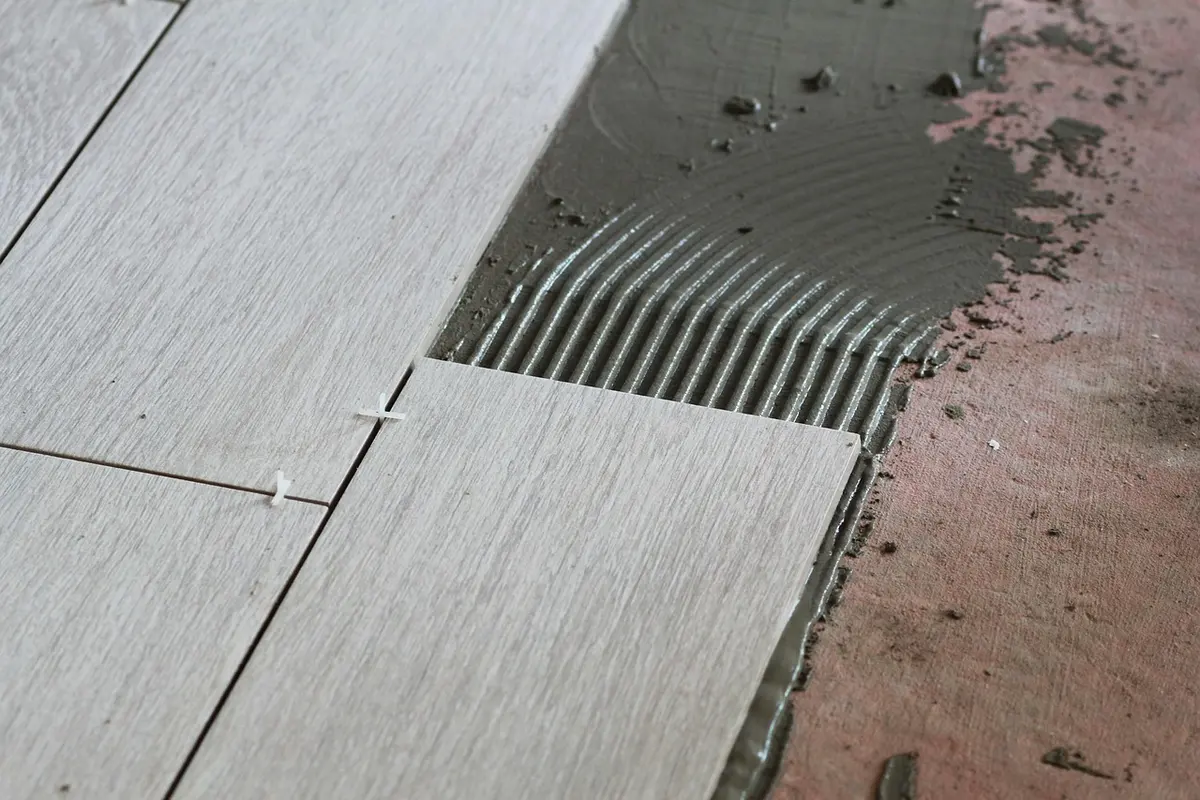
Set in the appropriate thinset for the tile and the substrate, with full coverage on the back of every piece. Large-format tile and natural stone have their own requirements, and stone needs sealing.
The movement joints
Every change of plane — every internal corner, and the joint where the wall meets the pan — is filled with a flexible sealant rather than grout. Buildings move; grout is rigid and cracks when it is asked to flex. Grout in an internal corner is a crack waiting to happen and a very common shortcut.
Why the timeline looks the way it does
A tile shower takes longer than people expect, and most of the reason is waiting.
Membranes have to cure before they can be tested. A flood test, where the drain is plugged and the pan is filled and left, takes a day on its own and is the only way to prove the waterproofing works before it is buried under tile. Thinset has to cure before the tile can be grouted. Grout has to cure before sealant goes in.
Skipping the waiting is how a job gets compressed into a shorter timeline, and the shortcuts are invisible for several years, which is exactly the problem.
Things worth deciding before the job starts
Niche or no niche. A recessed niche is far better than a hanging caddy and needs to be positioned between studs and detailed before the waterproofing goes on. It cannot be added later.
Bench or no bench. Same reasoning, and a bench in a small shower costs more floor space than the drawing suggests.
Curb or curbless. A curbless entry is a genuinely good thing to build into a house you intend to stay in, but it needs the floor structure to be recessed and is much easier to plan than to retrofit.
Tile size. Large tiles mean less grout to clean and fewer joints, but a small shower floor needs enough joints to follow the slope to the drain — which is why floors are usually smaller-format than walls.
Grout color. A color close to the tile hides the grid and makes the shower read as one surface. A contrasting color makes a feature of the pattern and shows every deviation, so it wants a very well-set tile.
What we do and what we do not
Tile showers are one of the four things we specialise in, alongside carpet, laminate and luxury vinyl plank, and quartz counters. We build the whole system, not just the tiling.
What we do not do is take on repair work for tile, hard surface flooring or countertops on projects we did not install. That is not us being awkward — it is that we cannot warrant a waterproofing system we did not build and cannot see without opening the wall. Where somebody else's shower has failed, the honest answer is usually to rebuild it rather than patch it, because the failure is behind the tile rather than in it.
We are licensed with the Oregon Construction Contractors Board under CCB 103259, and our installation work carries a ten year labor warranty.
If you are planning a bathroom, come and talk it through at 900 Industrial Parkway in Newberg, Monday to Friday. Estimates are free and we come out to measure.
Related services: tile installation.