Of every part of a flooring job, the staircase gets the least thought in the showroom and the most attention afterwards. You walk it a dozen times a day, you see it from the front door, and it is the one place in the house where an average installation cannot hide under a sofa.
It is also the question that comes up most in two-storey houses: should the new floor carry on down the stairs, or should the stairs stay carpet? For most houses there is a right answer, and it is not always the one that looks best in a photograph.
Why stairs are their own job
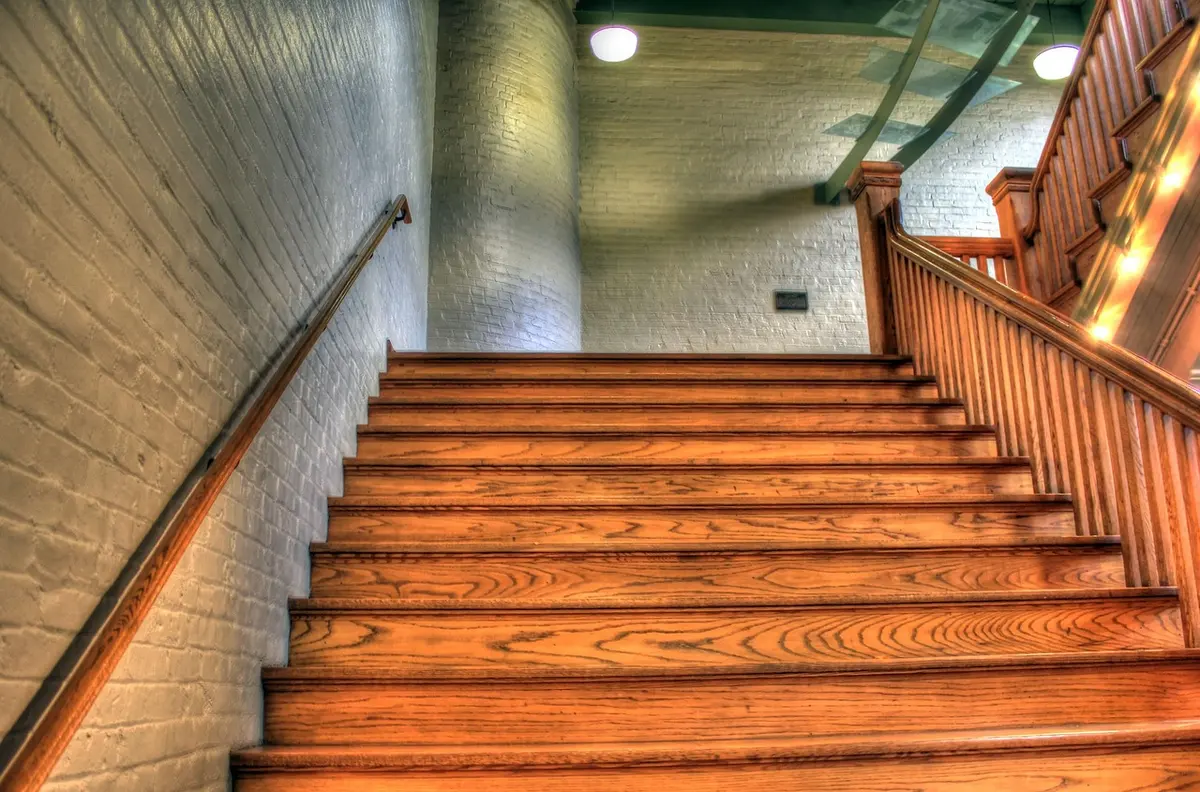
A floor is one surface. A staircase is a dozen or more small ones, each cut and fitted separately: the tread you stand on, the riser at the back, and the nosing at the front edge that takes the impact of every step.
That is why stairs are priced by the tread rather than by the square foot, and why we quote them as their own line. Two flights with the same number of steps can be very different jobs. An open side, a winding turn, a half-landing, or a staircase that meets two different floors at the top and bottom all add fitting time, and none of it shows up in a square footage.
Carpet on stairs: still the default, for good reasons
Carpet is still the most common choice on stairs, including in houses where every other room is hard flooring.
- It is quieter. A hard staircase in an open-plan house carries every footstep through the building.
- It is safer underfoot. Carpet grips in socks and gives a softer landing when somebody does slip, which matters with small children and older adults.
- It is kinder to dogs. An older dog that manages carpeted stairs comfortably can struggle on a hard surface.
- It replaces easily. One flight can be redone without touching the floors around it.
The catch is that stairs are the hardest place in the house for carpet to live. The carpet bends over the nosing of every step and gets scuffed there each time someone uses it, so stair carpet shows wear before any room does. That changes what you should buy.
Density over plushness. A tight, dense carpet holds up on a nosing. A soft, deep pile that feels wonderful in a bedroom opens up at the edge of the step and shows the backing. Choosing carpet that lasts covers how to read a sample.
A firm pad, not a thick one. A deep, spongy pad makes each step feel vague underfoot and lets the carpet flex over the nosing, which wears it faster. On stairs the pad should be firmer than you would pick for a bedroom.
Cut pile if you have cats. A claw caught in a loop at the edge of a step can pull a run down the flight. Cut pile has no loops to catch.
Hard flooring on stairs: superb when it is done properly
Carrying luxury vinyl plank or laminate down the stairs gives the house one continuous floor. On an open-plan main level where the staircase is on show, it can look far better than a carpeted flight in the middle of a hard floor.
It is also the version where shortcuts show first. Three things decide whether it works.
Purpose-made stair nosings. The front edge of every step needs a nosing designed for it and matched to the floor, not a plank cut and glued over the edge of the tread. The nosing takes the wear and the impact. A cut plank edge chips and lifts.
Fixed, not floated. Across a room, LVP and laminate usually float. On a stair they cannot, because a surface that shifts underfoot on a step is dangerous. Every piece is bonded and fixed to the stair.
Grip. A smooth, glossy tread is slippery in socks. A matte finish with real texture is safer, and it hides wear better too. The same logic runs through our pet-friendly flooring guide.
Hard stairs are louder, and they are less forgiving of a fall. In a house with toddlers or an elderly dog, that is worth weighing honestly against the look.
What is under the old carpet
People often lift the carpet at the bottom step hoping to find hardwood stairs. Occasionally they do. More often, a staircase that was built to be carpeted has plain construction-grade treads underneath, often with a rounded front edge that was only ever meant to have carpet wrapped over it.
That is not a problem, but it does decide the job. Those treads are not a finished surface, and a hard floor cannot simply go on top of a rounded edge. The stair has to be prepared to take a proper nosing, which is part of why a hard-surface staircase costs more than carpeting the same flight.
It is also the moment to deal with squeaks. A creaking step is usually movement between the tread and the structure beneath it, and with the covering off it can often be refastened. We tell you what we find before we do anything about it. More on what turns up under old floors in what we find under your old floor.
Decide the stairs with the floors either side
You see a staircase together with the landing at the top and the hallway at the bottom, so it should never be chosen on its own.
- Carpet stairs between hard floors look intentional when the carpet is a clear contrast and the transitions at the top and bottom are clean. A carpet that almost matches the plank looks like a mistake.
- Hard stairs should use the same product and color as the floor they come off, with plank direction planned so the flight reads as part of that floor.
- Split-levels and daylight basements, common in West Linn and Lake Oswego, show two levels at once from the stairs. Decide both floors and the flight together.
Matching flooring through the house goes further into getting the transitions between rooms right.
Our honest recommendation
For most houses on the Westside: carpet the stairs if there are small children, an older dog, bedrooms upstairs, or an open layout where noise travels. Take the hard floor down the stairs if the staircase is a feature of the main room, the household is past the toddler stage, and you are prepared to pay for proper nosings and a careful installer.
Either way, the staircase is where an installer's skill is most visible. When you compare companies, ask each one how they finish a nosing.
Get the stairs quoted properly
If the stairs are the only thing on your list, give us a call first. There is a minimum on any job, and we would rather tell you up front whether it makes sense. If they are part of a bigger floor, we price them as their own line so you can see exactly what they cost.
The estimate is free, and we bring samples to the house so you can hold a carpet or a nosing against your actual staircase. Norman's has been fitting floors from Newberg since 1978, and every install carries a ten year labor warranty on top of the manufacturer's warranty on the material. See stairs and trim, or book an estimate.