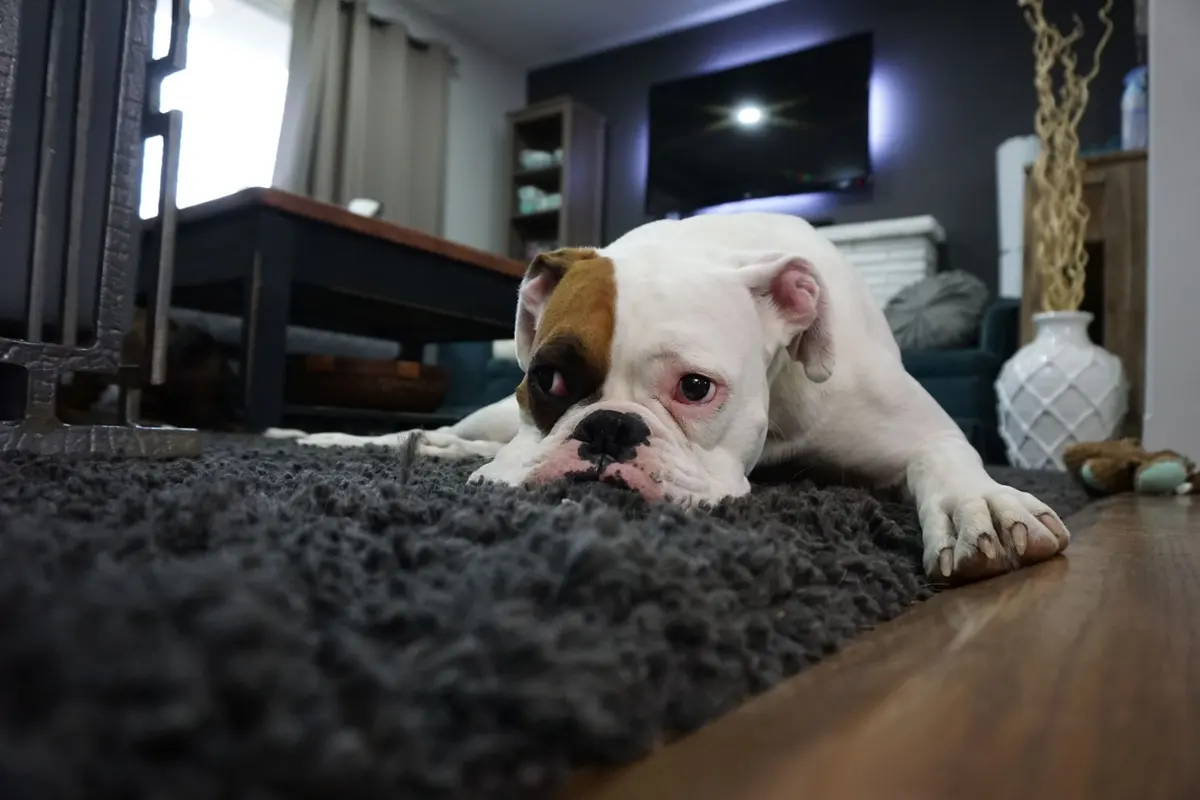
Search for pet-friendly flooring and you will be told luxury vinyl plank, every time, by everyone. It is not wrong. It is just not the whole answer, because pets damage a floor in three completely separate ways and no single product wins all three.
Getting this right means knowing which of the three is actually your problem.
The three failures
Scratching. Claws on a wear layer. Worst with big dogs, worst on stairs and in the runs where they accelerate.
Accidents. Liquid, sitting. The damage is rarely to the surface — it is to what is underneath.
Smell. The consequence of the second one going unnoticed. This is the failure that ends with the floor coming out, and it is the one people plan for least.
A puppy year and an elderly cat are different problems. So is a Labrador that comes in wet from the Willamette every weekend.
Scratching: what actually helps
The instinct is to buy the hardest floor available. Hardness helps, but far less than two other things.
Texture and pattern hide scratches; smoothness shows them. A wire-brushed or embossed plank with visible graining will absorb an enormous amount of wear before you notice. A smooth, uniform plank shows the first scratch.
Sheen matters more than hardness. High gloss is a magnifying glass. Every scratch catches the light along its length. Matte and low-sheen finishes hide the same damage almost completely. If you take one thing from this section, take that one.
On luxury vinyl plank the specification to look at is the wear layer, measured in mils. Under about 12 mil is a light-duty floor and not the right choice with a dog. Twenty mil is a genuinely tough residential floor. On laminate the number is the AC rating; AC4 and above is worth the small extra with pets, and laminate's wear layer is genuinely harder than most vinyl.
Nothing is scratch-proof. Anyone selling you scratch-proof is selling you a warranty with conditions in it. Trimmed nails do more for a floor than any upgrade on this list.
Accidents: the damage is underneath
Here is the part that surprises people. Almost every product sold today handles a puddle on its surface perfectly well. Vinyl is waterproof. A modern laminate survives a wiped-up spill. Tile does not care at all.
The problem is that a pet accident is not a puddle on a surface. It runs to the nearest edge and goes down.
On a floating floor — which laminate and most LVP are — that means the seams between planks and the perimeter gap around the room. Liquid that finds a seam gets under the floor, where it sits on the subfloor with a plastic sheet over it. The plank is fine. The subfloor is not.
On carpet, it goes straight through the fiber, through the pad, and into the subfloor. The carpet is the least affected layer of the three.
Which is why the honest ranking for accidents is:
- Tile, grouted and sealed, is the only genuinely sealed floor in a house. See tile.
- Glued-down vinyl beats floating vinyl, because there is no floating seam network for liquid to travel through.
- Floating LVP is fine if it is found quickly.
- Laminate is fine if it is found quickly and is not fine if it is not — the core is compressed wood fiber and it swells permanently.
- Carpet depends almost entirely on the pad.
Smell, and why replacing the carpet does not fix it
This is the one we get called about most, usually a month after somebody else replaced the carpet.
Odor is not in the carpet. It is in the pad and in the subfloor. Put new carpet over a contaminated subfloor and the house smells again as soon as it warms up, because you have covered the source rather than removed it. The fix is to pull the carpet and the pad, treat and seal the subfloor, and only then lay something new. What we find under an old floor covers what that actually looks like.
If you have a pet history in the house and you are putting in new carpet, specify a moisture-barrier pad. It is the single most useful upgrade in this entire guide. It costs a little and it stops the next accident becoming a subfloor problem.
Can you have carpet with pets? Yes, with conditions
We fit a lot of carpet in houses with animals and it works, provided three decisions go the right way.
Fiber. Solution-dyed nylon and the polymer fibers sold under names like SmartStrand resist staining because the color goes through the fiber rather than sitting on it, and they clean far better than an older stain-treated carpet. We carry Mohawk's SmartStrand and Karastan, among others.
Pile construction. With cats, avoid loop pile. A claw goes into a loop and pulls a run across the room. Cut pile has no loops to catch. With dogs it matters much less.
The pad. Moisture barrier, as above. Not optional in a house with animals.
More on the rest of the specification in choosing carpet that lasts, and on the product range in carpet.
What we would put in a Newberg house with two dogs
Main level, entry and hallway: rigid-core luxury vinyl plank, 20 mil wear layer, matte finish, mid-tone with visible graining. That combination survives claws, hides what it does not survive, and is the easiest floor in the house to wipe down after a wet walk.
Bedrooms: solution-dyed nylon carpet over a moisture-barrier pad, because a bedroom is where comfort wins and traffic is low.
Mudroom or laundry, if there is one: tile. It is the only room where the extra cost of tile pays for itself in a pet house.
Stairs: carpet, usually. It is quieter, it is safer for an older dog, and it is far easier to replace one flight than a whole floor. See stairs and trim.
Three traps worth avoiding
- Dark, high-gloss floors. They show every scratch, every hair and every dried paw print. They photograph beautifully and live badly.
- Rubber-backed mats on vinyl. Some rubber backings react with vinyl and leave a permanent stain. Use a felt-backed rug pad instead.
- Very wide planks in a wet-dog house. Wide planks mean fewer seams, which is good, but they also move more with humidity, and a floor that moves opens seams. Ask about it rather than assuming.
Come and put a claw to it
The showroom at 900 Industrial Parkway has samples out, and we will hand you a key and tell you to scratch one. It is a more honest test than any number on a tag. We also bring samples to the house, which is worth doing here because matte and low-sheen finishes read completely differently in a real room than under showroom lights. The fibers and wear layers that hold up to pets are compared brand by brand in the flooring brands we carry.
Norman's has been fitting floors on Portland's Westside since 1978. Every install carries a ten year labor warranty. Book a free estimate and bring the dog into the conversation — it changes the recommendation.