Luxury vinyl plank has taken over the middle of the flooring market, and in a wet region it has taken over the kitchen, the entry and the laundry almost completely. It takes water, it takes dogs, it takes dragged furniture, and the good ones are genuinely convincing. It has also filled up with products that look identical in a showroom and are not remotely the same floor, which is where the price confusion comes from.
This guide covers what LVP costs installed across Newberg and Portland's Westside, what the quote is made of, and the two things that move it most: the wear layer you choose and the subfloor you already have.
The range, honestly
Across Oregon, luxury vinyl plank installed typically runs from around five dollars per square foot for a thinner-wear-layer plank over a sound, flat subfloor, up to ten or twelve dollars per square foot for a thick-wear-layer rigid-core product with subfloor preparation. A whole main floor of a family house usually lands in the mid thousands, with the specification and the condition of the subfloor deciding where.
Those are market ranges rather than a price list. Every job is measured in person, and the subfloor is looked at before the number is written, because that is where the surprises live.
What is inside the quote
The plank. Priced by the square foot, and the number with the widest range. Wear layer thickness, core construction and the quality of the print and embossing decide it.
Underlayment. Many rigid-core planks have a pad attached; others need a separate underlayment. Over a concrete slab, a vapor barrier is required and is not optional.
Subfloor preparation. Flattening, patching, refastening or, in the worst cases, replacing sections of the subfloor. This is the line that is missing from a quote produced without a site visit, and the one that appears as a surprise on install day if it was skipped.
Labor. Removal of the old floor, preparation, laying the floor with a real expansion gap at every wall, and finishing with transitions and trim.
Removal and disposal. We quote this as part of the job.
The wear layer is where the money should go
The wear layer is the clear coating on top of the plank that takes the scratching, measured in mils. A thin wear layer and a thick one can look identical in the showroom and behave completely differently under a dog's claws or a kitchen chair. It is the single most important specification on a vinyl plank and the best place to spend money on the job.
A quiet couple can be well served by something modest. A family with two dogs, children and a front door that gets used should be paying for a thicker wear layer, and it is a smaller step up in price than most people expect. Rather than quoting a number in the abstract, tell us who lives in the house and how the rooms are used, and we will point at the right shelf.
The core matters too. A rigid core handles an uneven subfloor and temperature swing better than a flexible one, and in a Willamette Valley house that swings between damp and dry seasons, that stability is worth having. TRUCOR and the rigid-core lines from Mannington and Mohawk are what we specify most for main floors; our guide to the brands we carry explains the differences.
The subfloor is the surprise
LVP is thin, and it shows what is underneath it. A dip in the subfloor that carpet would hide becomes a hollow, clicky spot under a floating vinyl floor, and a ridge telegraphs through as a line. Preparation is not optional, and it belongs in the quote.
What we find depends on the house. Post-1990 subdivisions around Newberg, Sherwood and Wilsonville usually have flat subfloors and predictable work. Ranches and split-levels from the 1960s to 1980s across Tigard, Tualatin and Beaverton often have particleboard underlayment that has been wet at some point under an old kitchen vinyl, and particleboard that has been wet cannot be built over. Older houses near downtown have settled subfloors that need flattening. We covered all of it in what we find under your old floor.
Over concrete, the slab is tested for moisture and a vapor barrier goes down. Skipping that is how a floating floor over a slab ends up cupping a year later.
Can it go over the existing floor?
Sometimes, and it saves the removal cost when it can. Over a sound, flat, well-bonded surface, LVP can be a good option. Over old sheet vinyl on swollen particleboard, or anything loose or uneven, it just buries a problem that shows through within a year. We tell you which one you have before you decide.
What else moves the number
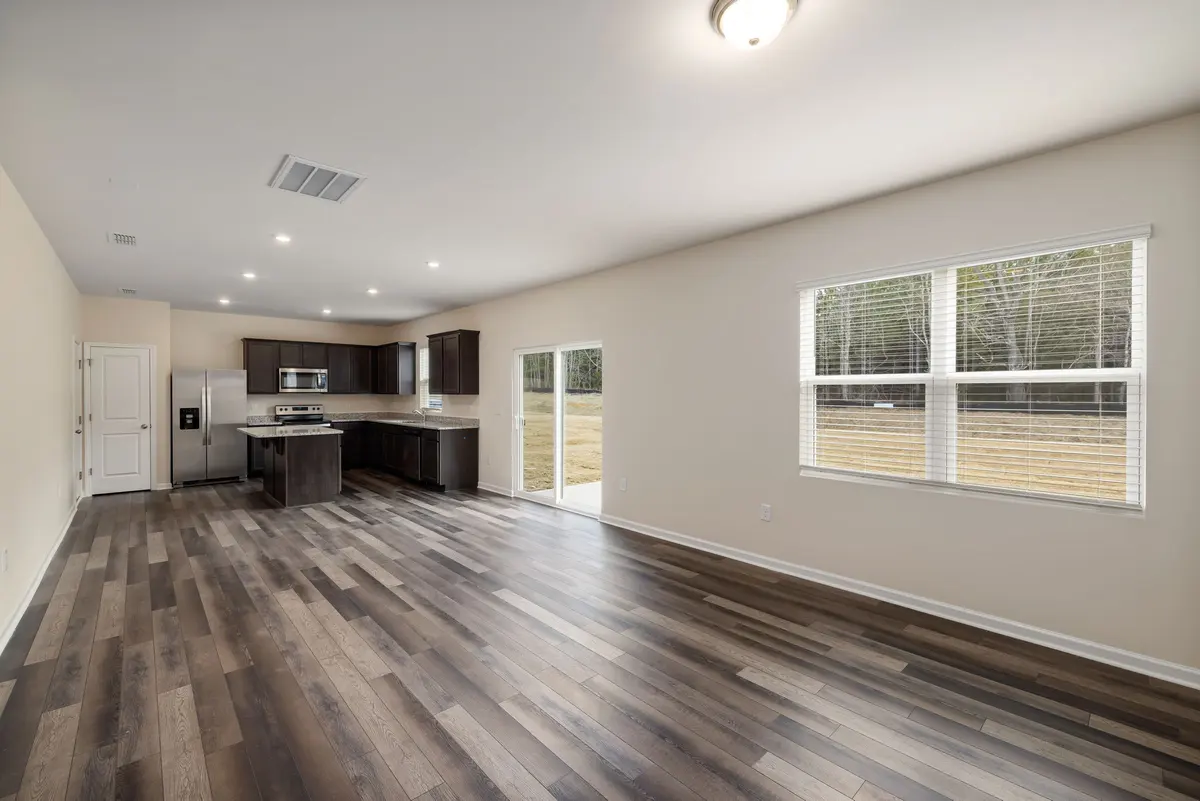
- Room shape and layout. An open-plan main floor with few walls is efficient. A house cut into many small rooms with many doorways takes longer and uses more transitions.
- Stairs. A hard surface can continue down a staircase, and it looks excellent when done with purpose-made stair nosings. It is skilled work and it is quoted as its own line.
- Trim. A floating floor needs an expansion gap hidden under the base. Where the existing base cannot be removed and refitted cleanly, a quarter round or new base goes in, and it is a line on the quote.
- Pattern. A herringbone or chevron layout uses more material and takes longer than a straight lay.
How the timing works
Most single-floor LVP jobs are one to three days of installation depending on the preparation, and the material lead time before that is usually a week or two. The plank acclimates in the room it will live in before it goes down. How long new flooring actually takes covers the sequence.
The honest comparison
Against carpet, LVP costs more per square foot installed and lasts longer in a traffic lane, which is why the usual pattern in a Willamette Valley house is LVP through the living areas, kitchen and wet rooms with carpet in the bedrooms. Carpet or LVP, room by room sets out how we make that call, and what carpet installation costs covers the carpet side of the budget. Against laminate, LVP wins where water is a factor and laminate wins on wear surface and looks for the money; see laminate vs luxury vinyl plank.
Norman's Floor Covering has been installing floors on Portland's Westside since 1978, licensed under CCB 103259, with a ten year labor warranty on every install. Financing through Wisetack is available. The showroom is at 900 Industrial Parkway in Newberg, and in-home estimates are free across the Westside and the north Willamette Valley. Our luxury vinyl plank page has more on the product itself, and what flooring costs in Oregon compares LVP with everything else we install.